The Field Guide Series for Mathematics
Field Guides for Mathematics: Complex Analysis
Analytic Functions, Integrals, Residues, and Conformal Mapping
This volume follows the classical route from complex numbers and elementary analytic functions through Cauchy theory, power and Laurent series, residues, zero counting, and conformal mapping.
Request a review copy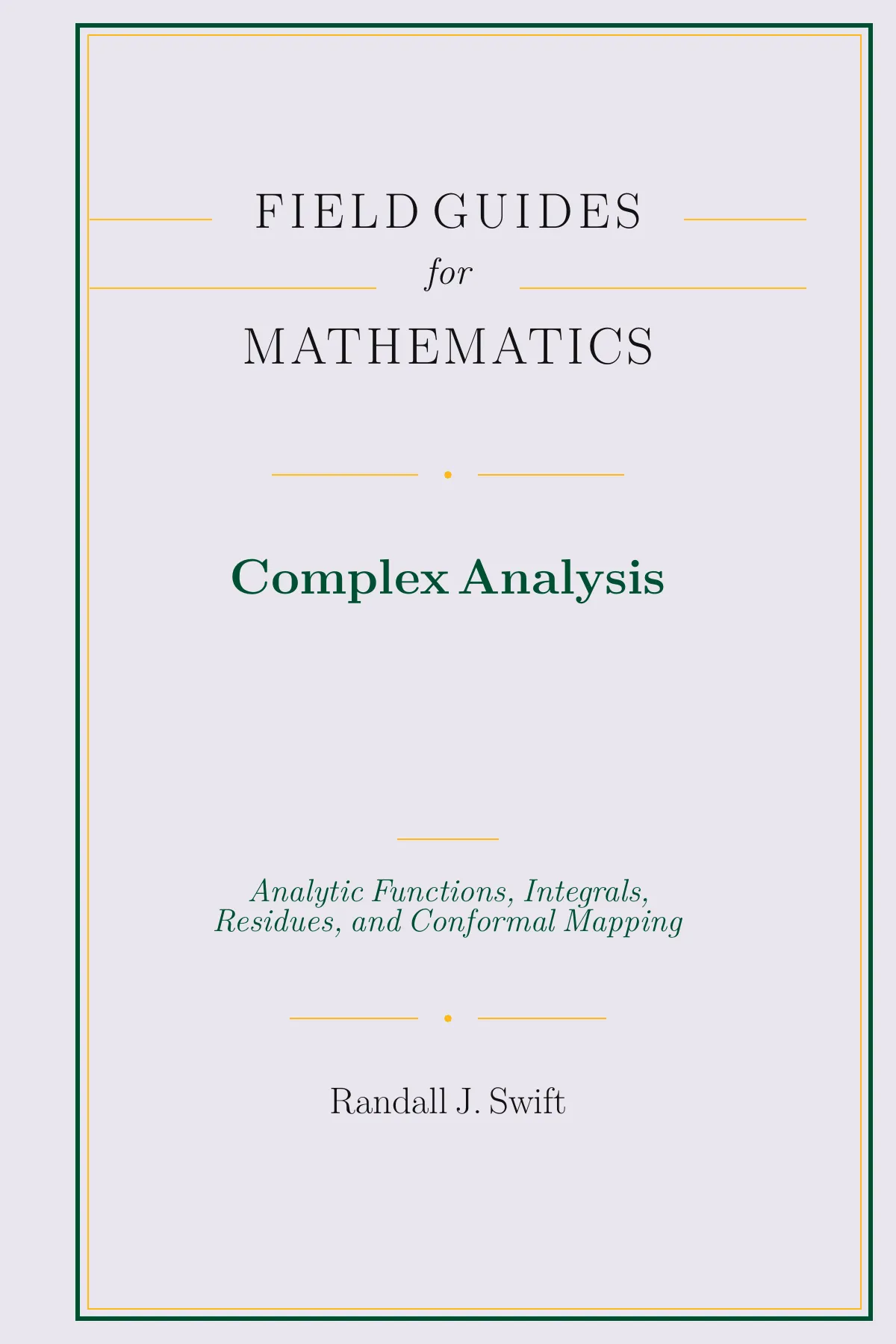
One publication · One product · Four coordinated PDFs
Four coordinated formats for each topic
The Field Guide Series for Mathematics is a coordinated collection of concise, visual resources designed to help readers learn mathematical structure, recognize the right ideas quickly, practice with purpose, and integrate methods across a topic.
The four PDFs share notation, visual cues, and a common mathematical vocabulary while serving different study tasks. Each is designed to remain useful beside a textbook, notebook, or computer rather than replace a full course text.
- 01
Field Guide — Learn.
Gathers essential ideas, formulas, characteristic behavior, examples, warnings, visual maps, and connections.
- 02
Field Cards — Recognize.
Compresses the same mathematical vocabulary into portable two-sided references.
- 03
Field Workbook — Practice.
Turns recognition into calculation, interpretation, and exploration.
- 04
Field Companion — Integrate.
Places Learn, Recognize, and Practice together by mathematical topic.
Inside this topic
About Complex Analysis
Complex analysis is unusually unified. A local derivative condition becomes the Cauchy-Riemann equations and harmonicity; contour integration leads to Cauchy theory and power series; Laurent coefficients describe singularities; residues turn local singular data into global integrals and sums; and conformal maps carry geometry and boundary-value problems from one domain to another.
The Field Guide follows the classical route while emphasizing recognition: what features of a problem signal analyticity, a contour theorem, a series expansion, a residue calculation, a zero-counting argument, or a conformal map. Visual mapping atlases and recurring Recognize and Connections prompts keep the subject's local and global viewpoints tied together.
A useful working rule: Domain first, theorem second, calculation third.