Problems and Explorations in Probability
A Problem-Centered Introduction
A problem-centered first course in probability built on five hundred problems, from dice and cards through entropy, martingales, and Markov chains, with an answer, hint, or worked solution for every one.
About this publication
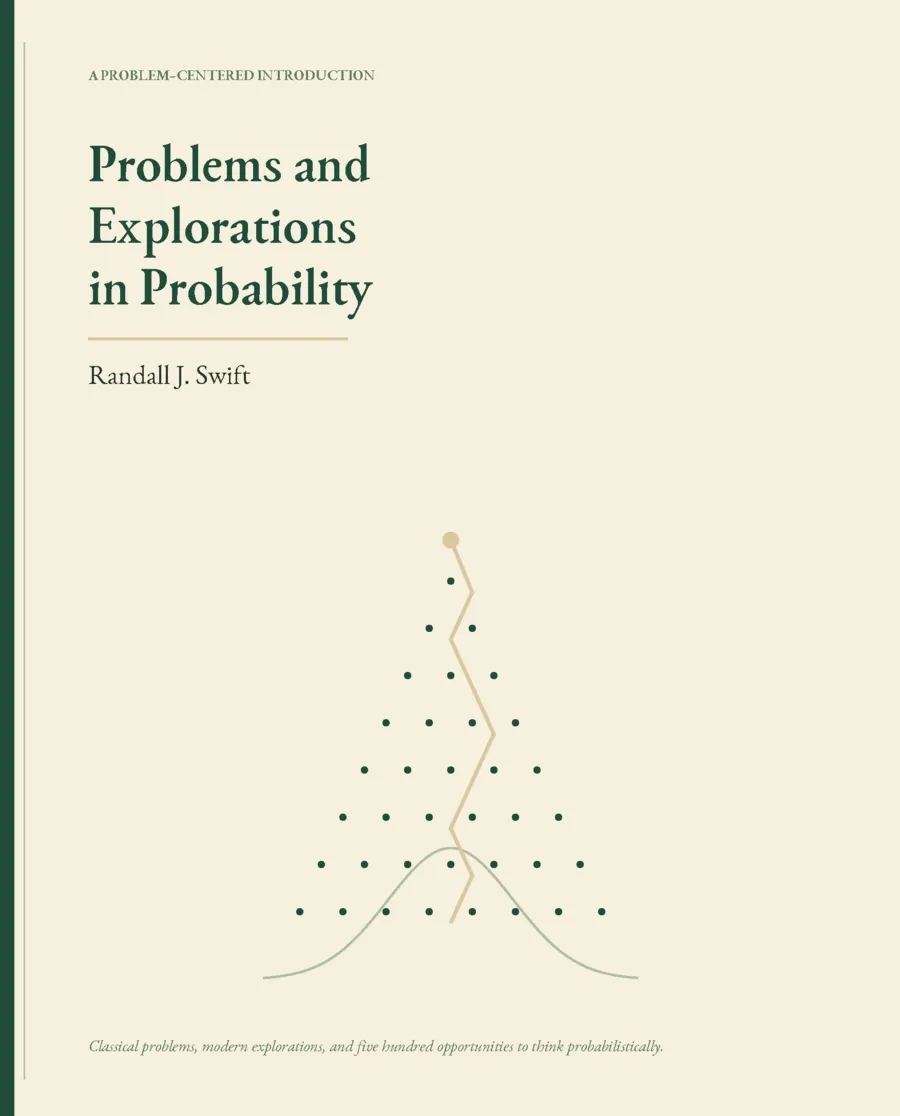
Textbook Media Press presents Problems and Explorations in Probability, a problem-centered introduction for a first undergraduate course. Its five hundred problems form the mathematical core of the book, while the exposition and worked examples, figures, historical remarks, and short explorations are intended to give a reader enough structure to begin working and perspective to understand why a method matters.
The problems move from relatively direct applications toward conceptual questions, proofs, and classical problems. Every problem has a corresponding answer, hint, or worked solution in the appendix, so the book can be used in a classroom, as a supplemental problem collection, or for independent study.
There are several reasonable paths through the book. A first course would cover Chapters 1 through 7. The 155 problems marked with a star provide a path through that material and make a reasonable foundation for a one-semester undergraduate probability course. The star is not a difficulty rating; it identifies the problems that collectively carry the main mathematical development. The surrounding unstarred problems can be used for additional practice, alternate examples, honors work, historical enrichment, or a second pass through the subject. Chapter 8 offers optional extensions into Poisson processes, finite Markov chains, random walks, branching processes, martingales, and computational probability.
Four continuing examples provide an additional route through the text. A box of colored marbles, a Galton board and its associated random walk, an arrival process, and a fair game are each revisited, every time with mathematical tools that were not available at their previous appearance. The marble box moves from sample spaces to counting, conditioning, distributions, laws of large numbers, and Pólya reinforcement. The Galton board becomes first a collection of paths, then a binomial model, a sum of small steps, a central-limit example, and finally a Markov chain. These recurring models show a characteristic feature of probability theory: the experiment may remain the same while new mathematical ideas reveal additional aspects.
Computation and simulation are used in the same spirit. Numerical experiments can test a conjecture using a spreadsheet, a statistical package, or generative AI tools that help translate a probabilistic specification into code. Two extended examples detail this use: one develops a marble-draw simulator, the other develops and checks a rectangular Galton-board simulator.
Prerequisites. Most of the manuscript can be studied after a two-semester calculus sequence. The portions of Chapter 6 dealing with multivariate continuous distributions and transformations of two random variables require familiarity with double integrals. Many of the author’s students studied probability while concurrently enrolled in Calculus III.
4 things to know about this book
- Flexible coverage can fit various courses. The text is designed for a first undergraduate course, independent study, or use as a supplemental problem collection. There is intentionally more material here than belongs in any one course, and there are several reasonable paths through it.
- The text is deliberately problem-centered. Its five hundred problems form the mathematical core of the book, while the exposition and worked examples, figures, historical remarks, and short explorations give a reader enough structure to begin working and perspective to understand why a method matters. Every problem has a corresponding answer, hint, or worked solution in the appendix.
- Classroom tested. The problems gathered here appeared in the author's classrooms, homework sets, exams, review sheets, and conversations prompted by questions students asked after class. Many hundreds of students have worked through versions of these problems at Western Kentucky University, Cal Poly Pomona, and elsewhere.
- Classical and contemporary. Dice, cards, marbles, roulette, waiting-time questions, the birthday problem, the problem of points, the St. Petersburg paradox, Buffon's needle, and gambler's ruin appear because these examples have endured. The book then follows those classical ideas into entropy and information, Pólya reinforcement and exchangeability, order statistics, concentration inequalities, martingales, branching processes, and Markov chains.
Brief table of contents
- 1. Sets, Sample Spaces, and Probability
- 2. Counting Methods and Finite Probability Models
- 3. Conditional Probability, Independence, and Bayes' Theorem
- 4. Discrete Random Variables and Distributions
- 5. Continuous Random Variables and Distributions
- 6. Joint Distributions and Transformations
- 7. Sampling Distributions and Limit Theorems
- 8. Stochastic Processes and Computational Probability
- Appendix A. Answers and Hints, plus references and a subject index